Robust Correspondence of CAD Drawings with Partial Optimal Transport
Valadri Sai Suraj ReddyAbstract
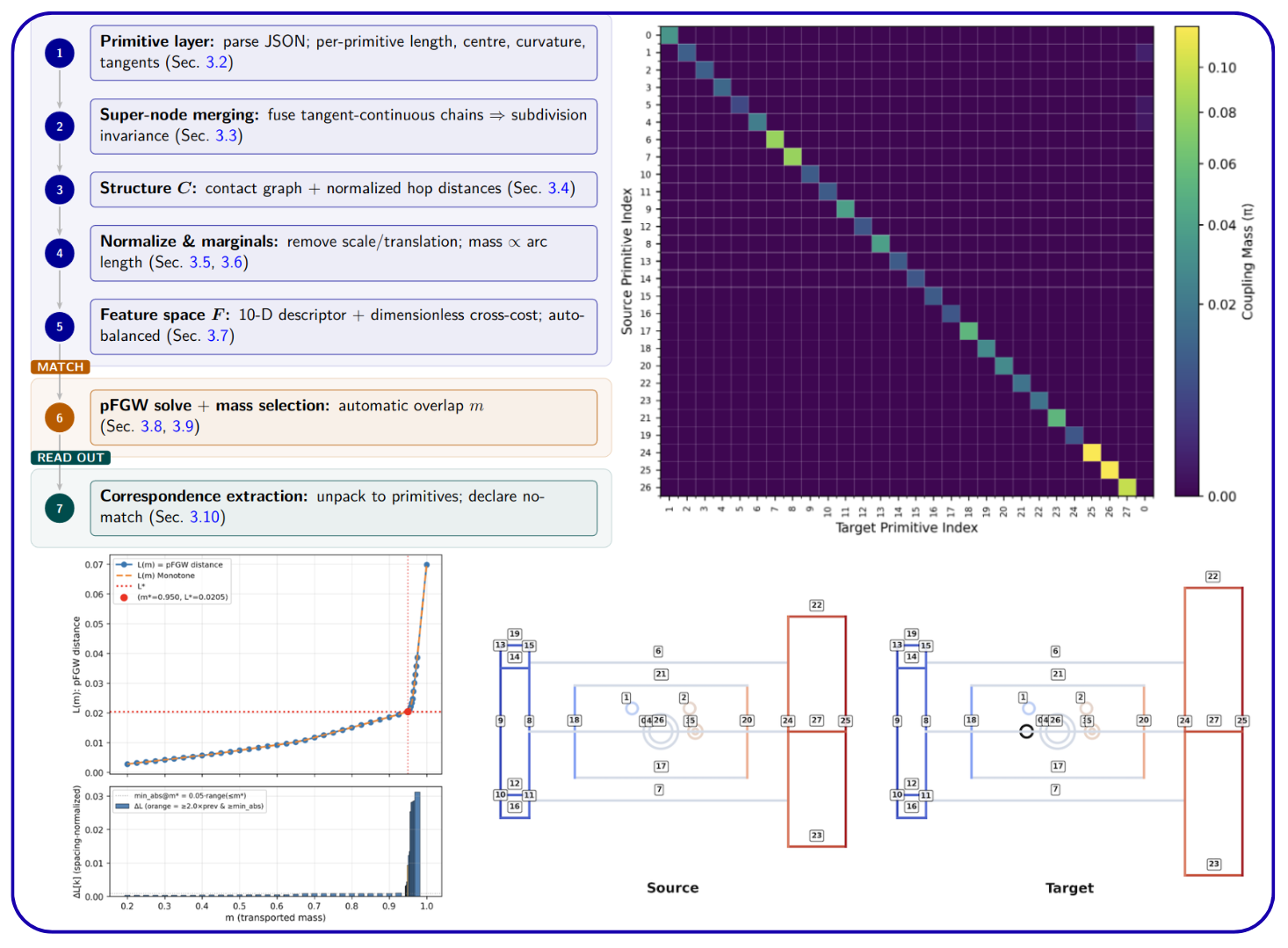
Establishing accurate correspondences between Computer-Aided Design (CAD) drawings underpins retrieval, design reuse, inspection, and change detection, yet two exports of the same shape rarely agree: they may sit in different frames (translation and scale), overlap only partially when features are added or removed, and subdivide the same geometry differently. We present a training-free pipeline that matches the primitives of one CAD drawing to those of another under all of these differences at once. Each drawing becomes a measured metric–feature space — a per-primitive descriptor unifying lines, circles, arcs, and splines; a contact-graph structure matrix; and length-proportional masses — and tangent-continuous chains are merged into subdivision-invariant super-nodes, so a shape matches whether it was exported as one curve or as many. Correspondence is solved as a Partial Fused Gromov–Wasserstein (pFGW) problem whose transported fraction — the unknown overlap — is selected automatically from the transport-cost curve, then unpacked into interpretable one-to-one and one-to-many matches with colour-coded visualizations for verification. To assess the matcher without the cost and ambiguity of hand-labelling, we further contribute an evaluation framework that synthesizes design-edit pairs whose ground-truth correspondence is known by construction: a vision–language model chooses realistic edits and a deterministic engine executes them exactly, yielding always-valid targets and exact correspondences for objective scoring — and laying the groundwork for a scalable, topology-aware CAD-matching benchmark.[PDF]