Vertical Structure-Based Composites for Analyzing Atmospheric Front Environments.
Anne Gossing, Miriam Kliemann, Vijay Natarajan, Stephan Pfahl, and Daniel Baum.Communications in Applied Mathematics and Computational Science, 2026, In Press.
Abstract
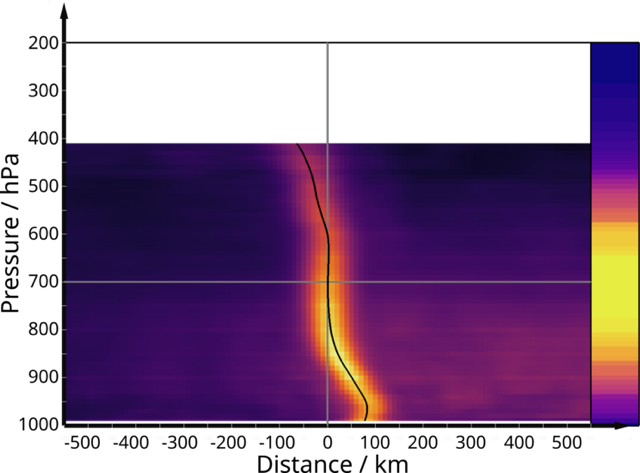
In many mid-latitude regions, a substantial fraction of extreme precipitation events occur in the vicinity of atmospheric fronts. To understand the processes that lead to such extreme precipitation, it is important to study the environment of the front. In this paper, we introduce a new method for computing vertical composites of frontal environments. Existing approaches construct such composites relative to front lines that represent the front at a single pressure level. However, fronts are vertically tilted and can exhibit substantial geometric variability, both within an individual front and between distinct events. Therefore, at levels away from the reference front line, the alignment of front environments based on a single front line commonly blurs the signals in the analyzed atmospheric variables. Our method accounts for the vertical structure of the front by computing composites relative to the actual front position at all height levels. We showcase the method using ERA5 reanalysis data for 50 cold fronts over Europe and apply it to thermodynamic and kinematic fields. Compared with conventional line-based composites, the new approach yields signals that are sharper and spatially more coherent. It also provides a visualization in which front-relative distances can be interpreted directly throughout the vertical column. Our method offers a general framework to study atmospheric processes in frontal environments and can be applied to different types and definitions of fronts.[PDF]